article
What is AIoT? The Evolving Definition for the Agentic Era
The Evolution: From Connectivity to Cognition
The definition of AIoT has never been static; it has continually advanced alongside leaps in AI technology.
- IoT (The Foundation): Initially, IoT was about connectivity. The focus was on digitizing physical assets, collecting data through sensors, and transporting that raw data into central platforms.
- AIoT 1.0 (The Traditional Era): This stage centered on applying Machine Learning (ML) models to vast time-series datasets generated by IoT devices. Custom-trained models detected patterns, enabling predictive maintenance and anomaly detection. However, this required significant data science expertise, along with large volumes of clean, labeled data.
- AIoT 2.0 (The Agentic Era): Today, we have entered the era of agentic AI — where reasoning and natural language interaction augment traditional analytics. The focus shifts from simply predicting an event to rapidly understanding why it is happening and providing actionable, human-centric insights.
The Foundational Requirements for AIoT
Success in AIoT begins with a robust IoT data foundation: without high-quality, contextualized data, even the most advanced AI will fail — it is the classic case of “garbage in, garbage out.”
Key steps in this foundation include:
- Connectivity and Onboarding: Securely integrating OT assets from the edge to the cloud.
- Data Ingestion and Transformation: Managing heterogeneous data streams and mapping them into usable formats.
- Data Contextualization: Placing sensor data into a wider business context (e.g., recognizing that a temperature reading belongs to Pump 3 on Line A). This contextualization unlocks richer analytics and more intelligent actions.
- Data Access: Delivering secure, governed access so that AI agents and applications can confidently leverage data at scale.
The Two Pathways of Modern AIoT
Once the foundational barriers of data management are addressed, AIoT can be realized through two complementary pathways.
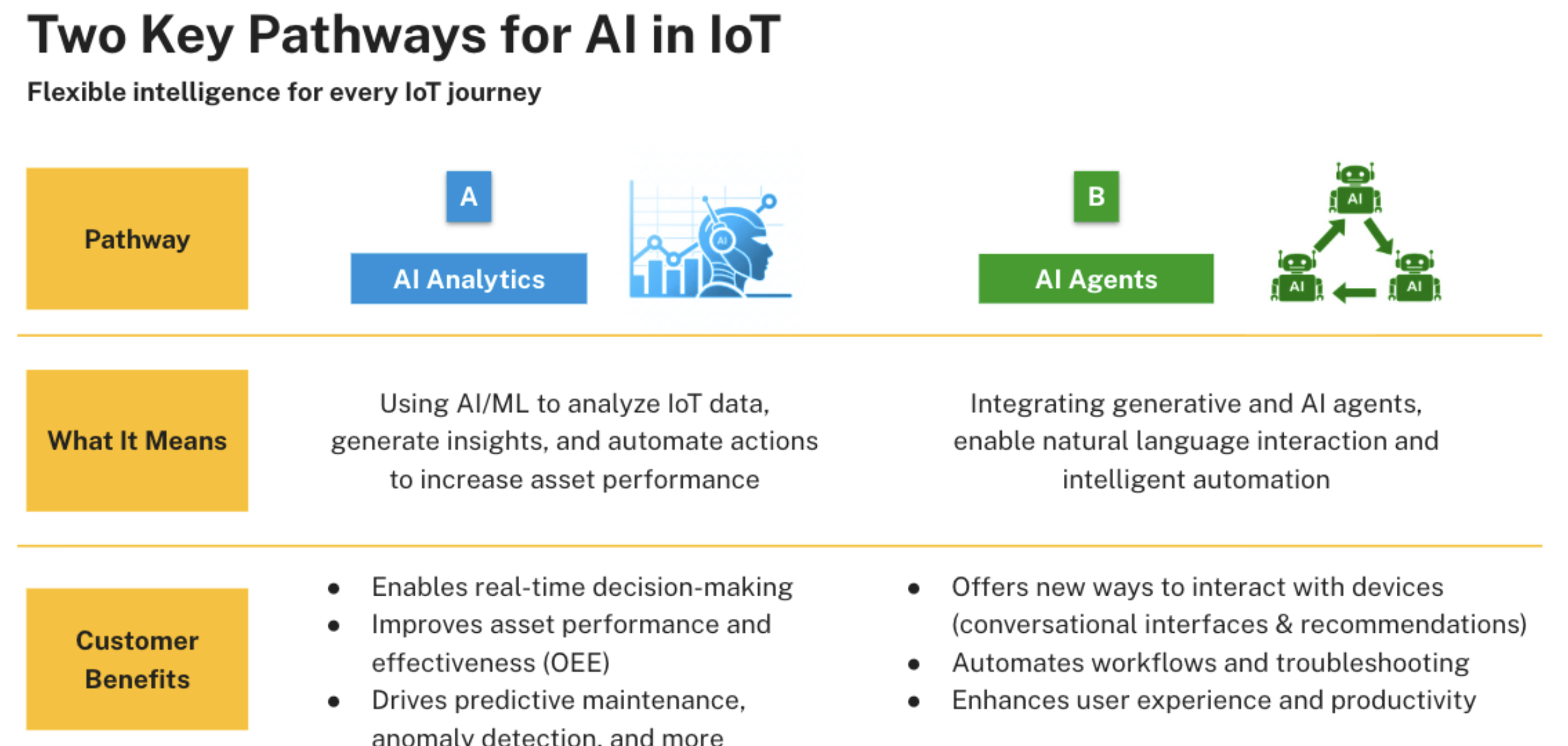
Pathway 1: AI Analytics (Learning from the Past)
This is the traditional, proven method of analyzing IoT data using models trained on historical datasets.
Key Benefits
- High ROI on Known Issues: Proven to reduce downtime and optimize maintenance.
- Edge-Friendly: Compact models can be deployed locally for low-latency decision-making.
- High Accuracy for Trained Tasks: Offers precise predictions for specific anomalies it was trained to detect.
Key Challenges
- High Barrier to Entry: Requires significant data science expertise.
- Data Dependency: Relies on large volumes of clean, labeled data.
- Slow to Adapt: Struggles with novel failure modes or issues, requiring re-training.
Pathway 2: Agentic AI for Natural Language Reasoning
This pathway leverages Large Language Models (LLMs) as reasoning engines. The focus is on natural language interaction, empowering users to query, troubleshoot, and act on IoT data without needing deep technical knowledge.
How It Works: The agent enters a Reason-Act-Observe loop. It interprets a natural language query (e.g., “Why did Asset X’s efficiency drop?”), reasons about the best plan, queries contextual data via the digital twin, observes the response, and delivers a clear, human-readable explanation.
Key Benefits
- Accelerated Troubleshooting: Rapidly identifies root causes and reduces time-to-insight.
- Zero-Shot Learning: Can work without custom training, leveraging real-time data and documentation.
- Democratized Access: Enables business users to interact with IoT data in natural language rather than dashboards or APIs.
Key Challenges
- Context Management: Ensuring the agent has complete and accurate real-time and historical data.
- Hallucination Risk: LLMs can fabricate insights if context is poor; validation guardrails are essential.
- Computational Cost: LLM inference can be resource-intensive compared to smaller ML models.
Future Outlook: Autonomous Agentic Action
Today’s focus is on augmenting human decision-making, but tomorrow’s AIoT vision is full autonomy. This next phase — Agentic Automation — will move beyond explanation to autonomous action in the physical world.
Capabilities will include:
- Dynamic Workflow Generation: Agents automatically executing multi-step remediation plans (e.g., generating maintenance work orders, adjusting production line speeds, and notifying supply chain systems).
- Multi-Agent Coordination: Specialized agents collaborating like a digital operations team — one monitoring energy, another optimizing logistics, and another ensuring quality control — all driving towards enterprise goals.
Achieving this requires maturity in trust, explainable AI (XAI), and robust guardrails to ensure safe and reliable outcomes.
Getting Started: Practical Next Steps
To begin or accelerate your AIoT journey, focus on building the right data structure and piloting new tools with high-impact use cases:
- Establish the Data Foundation: Prioritize clean, contextualized asset data in your IoT platform. This is the single most critical step; without this you will get “garbage in, garbage out.”
- Identify a High-Value Use Case for AI Analytics: Start with a clearly defined challenge such as predictive maintenance on critical assets or vision AI for defect detection.
- Build a Digital Twin Foundation: Connect metadata, relationships, and time-series data for assets into a digital twin to provide context for AI agents.
- Pilot a Natural Language Query Agent: Test a simple application that queries your digital twin (e.g., “What were Pump B’s average vibration readings last month?”) to validate NLI interfaces.
- Integrate Insights: Combine traditional AI Analytics (Pathway 1) with Agentic AI (Pathway 2). This creates a synergy where the agent can say: “Pump B will likely fail in 3 days (from ML) and here’s the root cause (from LLM reasoning).”
Closing Perspective
AIoT has evolved from a data-collection exercise into a transformative force for autonomous, agent-driven action. Businesses that establish the right data foundations today will be positioned not only to predict and understand events, but to act on them dynamically, securely, and at scale.
Cumulocity IoT provides the enterprise-grade foundation, trusted partner ecosystem, and future-ready architecture to make this next era of AIoT a reality.
Want to dive deeper into the topic; read this blog article by Nikolaus Neuerburg
Want to learn more about how AIoT is transforming industry?
Learn more about how organizations like yours are using AIoT to improve operations, speed decision-making, and introduce new business models to their customers.